Decisions in Agents
An agent decision maps a request to a small set of application-owned handlers. Use this when the next step has a known set of valid routes, such as order tracking, returns information, or clarification. A typed route is easier to validate and inspect than instructions that ask a model to invent a workflow.
Let’s route a support question. The server will decode a closed decision schema, check its confidence, then select a fixed read-only response. Uncertain input gets a clarification question.
Validate a decision before choosing a handler
Scroll horizontally to see the full diagram, or expand it.
Read the diagram
A TypeSafe envelope is decoded against a closed schema on the server. A valid known non-clarification route with finite confidence at or above the configured threshold selects a fixed read-only handler. Invalid envelopes, low confidence, explicit clarification, or an operationally unavailable classifier produce clarification. Cancellation suppresses late output; unexpected programming errors remain errors.
Route a support request on the server
This server helper works with either frontend. It receives an unknown decision envelope from the TypeSafe adapter, validates it with decodeDecision, and chooses only application-owned public information:
import { decodeDecision, s } from '@hashbrownai/core';

const supportSchema = s.object('Select a read-only support route', {
  route: s.enumeration('Choose returns, delivery, or clarify', [
    'returns',
    'delivery',
    'clarify',
  ]),
});

export function supportReply(response: unknown): string {
  const decision = decodeDecision(supportSchema, response);
  const score = decision.meta.route.confidence;
  if (!Number.isFinite(score) || score < 0.75 || score > 1) {
    return 'Do you mean delivery information or our returns policy?';
  }
  switch (decision.value.route) {
    case 'returns':
      return 'Public example policy: return unused items within 30 days.';
    case 'delivery':
      return 'Public example delivery window: three to five business days.';
    case 'clarify':
      return 'Do you mean delivery information or our returns policy?';
  }
}
Call HashbrownTypeSafe.decide from @hashbrownai/typesafe with this schema, a bounded user request, an abort signal, and server-only TYPESAFE_API_KEY and TYPESAFE_MODEL. Pass its returned envelope to supportReply; never route directly from unvalidated response JSON. This focused helper throws on an invalid envelope. The enclosing endpoint must handle DecisionResponseError and expected provider failures as clarification, propagate cancellation, and preserve unexpected programming errors.
The standalone support agent includes that complete error boundary, a bounded order-ID check, injected read-only handlers, and cancellation. Its server composition shows the real TypeSafe call. The standalone example uses a 0.7 threshold; the policy above and the recorded plan lesson use 0.75. Choose a threshold against representative requests. Neither value establishes authorization or calibrated accuracy.
Explore it in the workbench
The workbench below replays a recorded run of this lesson.
Inspect real TypeSafe route decisions and fixed application handler replies across two turns.
Recorded with real TypeSafe route decisions and whole application-owned handler text in the checked Angular workbench. Decision confidence gates only known read-only handlers; handler prose is not generated model text. Application state is unchanged. Unchanged protocol events are paced at 20 ms for filming; the normal host adds no delay. Footage is slowed to half speed for readability. Replay makes no requests or writes. No narration. Read the text walkthrough.
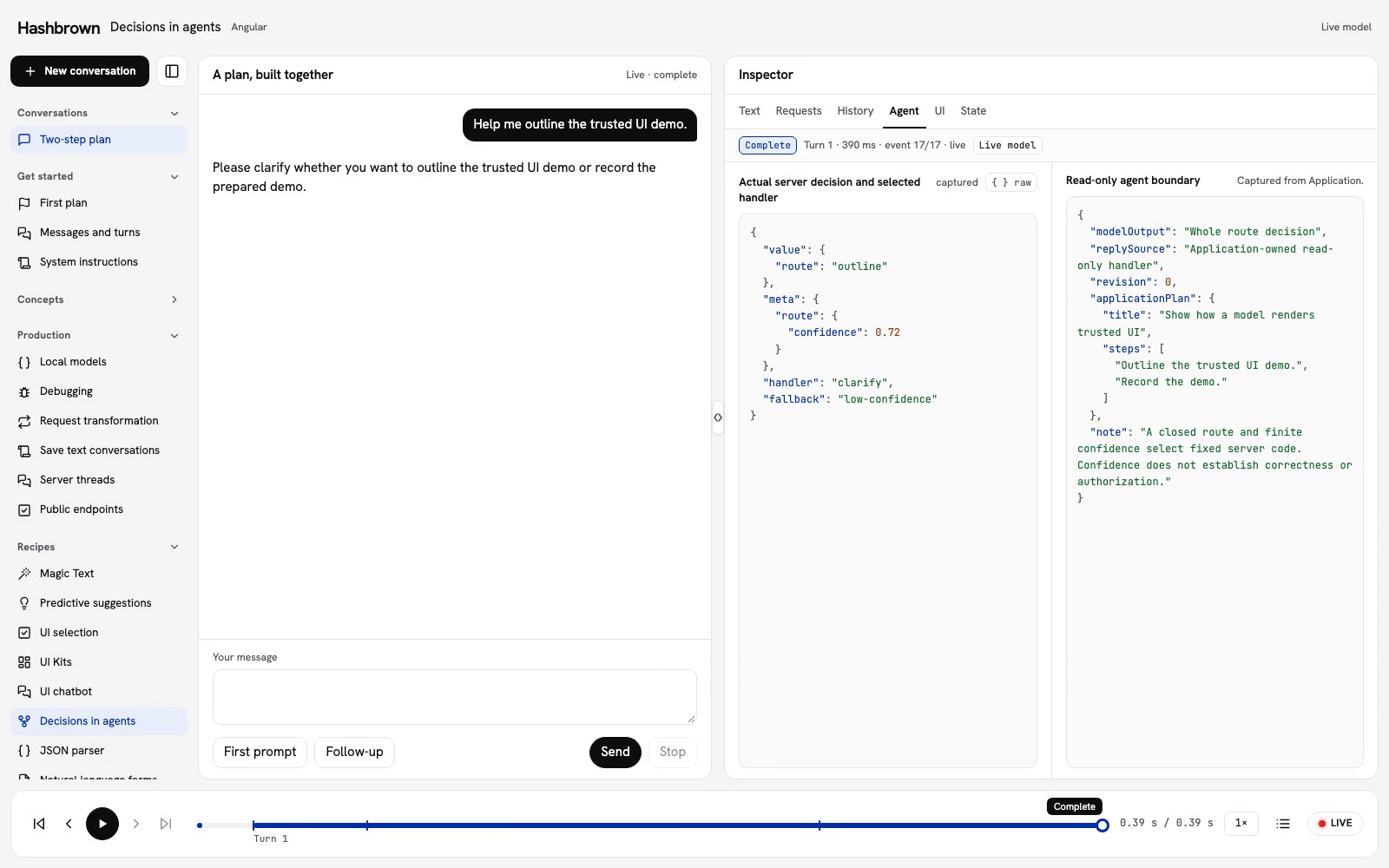
Let's put a decision inside our agent. We'll ask which part of the same two-step plan the user wants explained, then call our own outline or recording handler. When the choice is uncertain, we'll ask for clarification.
Follow the decision
- Open Decisions in agents in the canonical workbench.
- Ask for help outlining the trusted UI demo.
- Inspect Agent: the actual TypeSafe response chooses a known route and includes its confidence.
- When confidence passes the policy, our server calls the outline handler. A lower score returns a clarification reply.
- Ask how to record the prepared demo. Inspect the next proposed route and the handler permitted by its confidence.
- Replay both turns and compare their requests, route choices, handler replies, and unchanged application state.
The replay uses real TypeSafe decisions and keep the actual scores visible. A proposed route below 0.75 still produces clarification, even when that route looks reasonable. A decision response arrives whole. The reply is text supplied by our application handler; it is not streamed model prose.
Keep the routes small
The server owns three routes:
| Route | Application behavior |
|---|---|
outline | Explain how to prepare the trusted UI demonstration. |
record | Explain how to record the prepared demonstration. |
clarify | Ask which supported part of the plan the user means. |
The browser uses ordinary text chat. The server performs the classification inside the request, validates the response envelope, and selects a fixed handler. We do not need a browser decision hook to make this agent decision.
The model returns a route ID. It cannot supply executable code, choose an arbitrary endpoint, or replace the handlers. Both handlers read the same application-owned plan. Neither executes a step or changes application state.
Validate before routing
The checked schema defines a closed outline, record, or clarify choice. After decoding the envelope, the server checks that confidence is finite and between 0 and 1. Only a supported route at 0.75 or higher can select its handler.
A low score, invalid envelope, explicit clarification choice, or operationally unavailable classifier produces a clarification reply. Unexpected programming errors remain run errors. Cancellation suppresses late output instead of sending an old handler result into a newer conversation.
Confidence is a model score, not calibrated accuracy. Choose a threshold against representative requests. It does not establish correctness or authorization. A real data lookup still needs its own identity, ownership, and argument checks.
Read the actual trace
Requests shows the SDK's text request and decoded AG-UI events. The Agent view projects the server's custom trace: selected route, finite confidence, handler, and fallback reason. That trace contains allowlisted public values, not credentials or an unrestricted provider payload.
The trace and handler reply belong to the same captured run. A follow-up retains the conversation and gets a fresh run ID. Moving through history is read-only: Replay makes no classifier requests and repeats no handler or application action.
Configure the classifier
Use the checked workbench server and keep credentials in its server-only environment. The host uses OPENAI_API_KEY and OPENAI_MODEL for its other lessons. Add TYPESAFE_API_KEY and an exact TYPESAFE_MODEL available to your account for agent decisions. See TypeSafe.
The local host is a teaching example. Before connecting private data, add the application's authentication, ownership checks, admission limits, and durable state where required. See Securing a Public Endpoint.
Read the checked source
- Angular client uses actual framework text chat.
- Server agent wrapper calls TypeSafe, validates the decision, and selects a fixed handler.
- Route schema and safe trace define the closed contract.
- Shared capture and actions keep the neighboring parser and form lessons in the same conversation workbench.
Use Decisions for browser decision resources. Use UI selection when the model should choose among application-owned views.